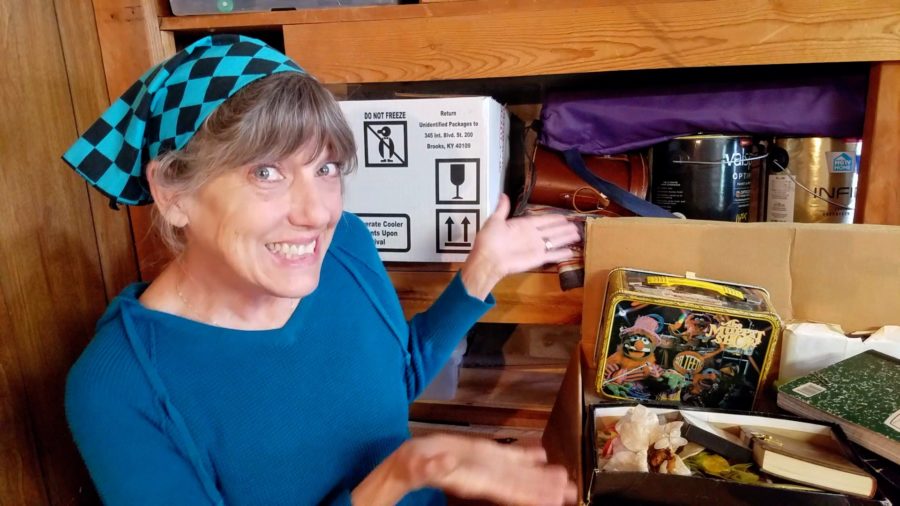
“In the time of a global pandemic, a community gathers online and starts sharing their memories of school lunches. The Good, the Bad, and the Leftovers. These memories of the past and a little bit of fantasy will help them get through the present.”
A bit of back story. With COVID-19 shutting everything down and hurting the art scene, I reached out to the Norman Arts Council to see if there was anything I do to help via film or live-streaming. They invited me to a Zoom meeting with leaders from other arts organizations in Norman where I offered some suggestions and my help.
One of the groups I connected with was Namron Players Theatre. Writer and director, Sheryl Martin, was trying to figure out how to do her play in the age of a pandemic. After telling me about the story, I suggested that everyone could do their parts as YouTube vlogs. Sheryl loved the idea.
In this article in The Oklahoman from Brandy McDonnell about how local theatres went online, Sheryl thanked me by saying, “Dennis is guiding us through the entire process. He’s doing the editing and making incredibly helpful suggestions. I am not sure that I could have done this without him – or if I had, I’m not sure I would be sane right at this moment.”
I’m happy to have been able to help! Editing for the film is complete. Lunch Box will premiere on Thursday, June 4, 2020, on Depot TV. Learn more at www.namronplayerstheatre.org
A time traveler’s interview goes sideways when the interviewee accuses him of having met in the past.
The audio recorder Quis held was real but fake in that he disguised the device to match Earth’s technology in the 2010s. The name on his fictional press badge clipped to his unremarkable black suit identified him as “Hank Williams.” The name was phony, too, of course. However, Quis had grown accustomed to the alias, regularly using the persona for interviews.
Quis carefully constructed a different identity for each interview, usually working for a local publication. Big names tended to be open to talking to local nobody journalists, Quis had discovered. Plus, the background helped with his forgettable persona so people wouldn’t follow up with someone who didn’t exist.
“Mr. Praevalens will see you now,” the secretary informed him.
From the photos on her desk, Hank bet she was a grandmother. She had that kind, grandmotherly vibe. She happily led the way to the office of John Praevalens, the CEO of Close Ground. The technology company dabbled in various avenues, catering to security for governments and businesses.
The golden doors to John’s office were a statement. They weren’t massive–they were standard size for French doors but with a pocket design. The doors depicted a battle in an Aztec-influenced art style. Quis made a note to ask John about the doors as the secretary separated them.
Upon entering, Quis felt a slight buzzing sensation. He almost overlooked the unnatural protection, but he recognized the technology.
Why would they have anti-teleportation security? Quis thought. This planet doesn’t have that at this time. It must be something else I’m sensing.
As an end-timer, Quis wasn’t concerned about having an exit strategy. He could phase through any material and retreat to his time machine. Still, he planned his interviews to avoid resorting to dramatic tactics.
“Hey, old sport,” John greeted with genuine kindness as he firmly shook hands with Quis.
The spry, 30-something John wore his trademark black pinstriped suit. Around his neck was a gold medallion depicting the sun in the same style as his door. The flat medallion was palm-sized. Quis had read an article about John’s devotion to the family heirloom, but seeing the necklace for himself added questions.
First, anti-teleportation and an artifact crafted by a deity or one of us, Quis thought. I’m starting to feel I did not prepare for this interview.
The secretary softly closed the doors behind her as she left the room.
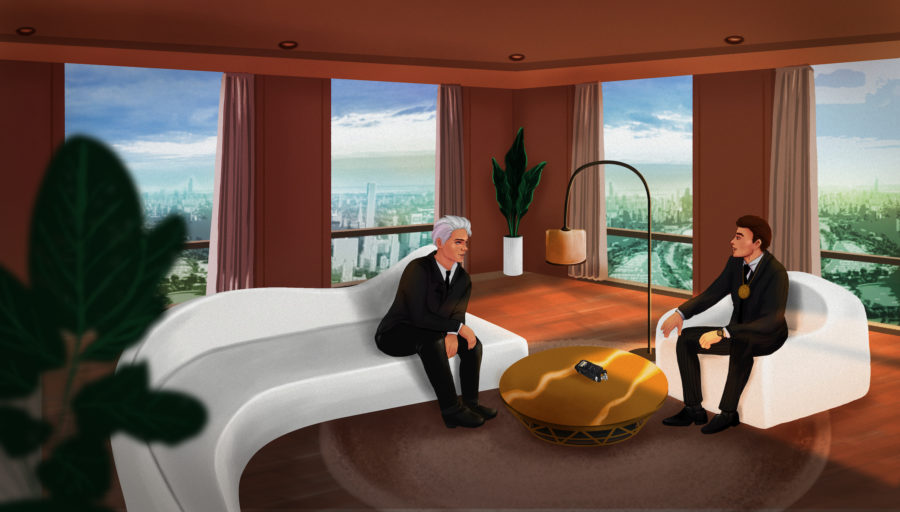
John led Quis to a modernism lounge area with an artistic golden coffee table and curvy, white leather sofas.
“Feel free to set your equipment on the table,” John offered as he took a seat on the couch. “Anything I can get you? A drink?”
Quis sat his audio recorder on the table and took a seat in a matching armchair. “I’m good, thank you. We can get started right away. Your time is valuable, so I appreciate you chatting with me.”
“You know, you remind me of someone. Have we met before, Hank?”
“No, I would remember you.”
John shifted around on his couch. “Odd. I’m pretty good at remembering people. Anyway, carry on.”
Quis pushed the record button. “I want to start by talking about your passions. What are some of the projects at Close Ground that excite you the most?”
“Starting deep, are we?”
“The best way to warm up is to jump in.”
John laughed. “You know, this one will surprise you, but I have to say, Exploring Earth.”
“The travel site?” Quis questioned.
“Yes, that’s the one.”
“Why?”
“I believe if people traveled more, and spoke with people from around the world, so much of our animosity would be gone. We got some fantastic contributors too. Amber Way showcases places with such enthusiasm that I swear, I want to visit every place she writes about.”
“There are countless stories to be collected,” Quis commented.
“Are you certain we hadn’t met before?” John asked, almost accusing him of lying.
“People tell me I have a familiar but forgetting face,” Quis joked.
John didn’t laugh. He leaned forward. “Everything about you seems familiar.”
“This is my first time interviewing you, sir,” Quis calmly reaffirmed, trying not to be annoyed.
“Yes, but I tend to remember everyone I’ve met. What are you?”
“I’m Hank,” Quis responded, unsure how to answer.
“I asked, what are you? You haven’t aged since you saved my life.”
Quis was now confused. “I beg your pardon?”
“Command Blackout,” John shouted into the room.
The window blinds dropped close. The buzz Quis had first felt when he entered intensified. All the lights went out except for the lamp that stood beside John. Hank’s recorder was still on.
“Your recording device should’ve lost power, which means it’s not from this world. Care to explain?”
“I-I don’t know what to tell you,” Quis stumbled. “Maybe you can tell me who you think I am, and we can figure this out.”
John took a deep breath and relaxed back into the couch. “You saved my life a hundred years ago, Quis.”
Quis’ jaw dropped. “Wait. You know my real name and a hundred years ago?”
John revealed his fangs. “Vampire.”
“Of course, that makes sense,” Quis said as he leaned back into his chair. “But how do we know each other?”
“You rescued me from that theatre fire in New Orleans and helped me fake my death there. Don’t you remember?”
“I’m a time-traveler,” Quis confessed. “For me, I haven’t saved your life yet.”
“Oh.” John was silent for a moment. “I hope I didn’t ruin anything by spoiling that for you.”
Quis chuckled. “It’s probably good that you told me because, unlike my others, I don’t interfere with the past. I only interview people for prosperity and to understand the universe’s life.”
“Well, shall we continue with the interview?”
“I’d like that,” Quis replied.
With the interview over, Quis returned to the alleyway where he left his time machine, a plain brown wooden door in a wood frame. Next to his door was a familiar green door and a familiar face inspecting a flame thrower.
“Gia!” Quis warmly called out to his fellow end-timer. “Good evening.”
Gia put away the flame thrower in her black leather jacket pocket, which was much larger on the inside. She shouted his name and ran up to him with a big hug. Quis returned the hug.
“Who were you interviewing this time?” Gia asked as she let go.
“John Praevalens. Did you know he was a vampire?”
“I didn’t know that. Fascinating.”
“What was that device you were toying with?”
“Just a flame thrower. I borrowed it from the labs at Close Ground. I need it for my play tonight. Want to come along and watch?”
Quis shrugged. “I’m up for a show. When and where?”
“New Orleans, 1919.”
This week’s short story was inspired by the following writing prompt: “You are the world’s only time-travelling journalist. You use carefully constructed false identities to secretly record your conversations with famous historical figures, and are sworn never to alter the past. However, when you meet with your latest unsuspecting interviewee, they recognize you.”
I took the basic premise of a time-traveling journalist and fitted it in my 16th Phoenix Universe, getting to introduce a new end-timer character, Quis. Quis (which is Latin for “who”) is one of a dozen people from the end of time, along with Gia, Slayer, Loki, Raven, and Kojack, who I’ve also written stories about. More to come as I explore and expand the universe.
Thank you for reading! Be sure to join me on Patreon for early access to my short stories and listen to my exclusive podcast.
Until visitors to Oklahoma Contemporary are able to take the Star Ceiling trip for themselves, Leo Villareal shares the origins of his work, the importance of public art and his mission to facilitate unforgettable art experiences in the latest installment of their Illuminations video series.
I was commissioned by the gallery to film and edit the interviews for their Illuminations series. Proud to share this video!
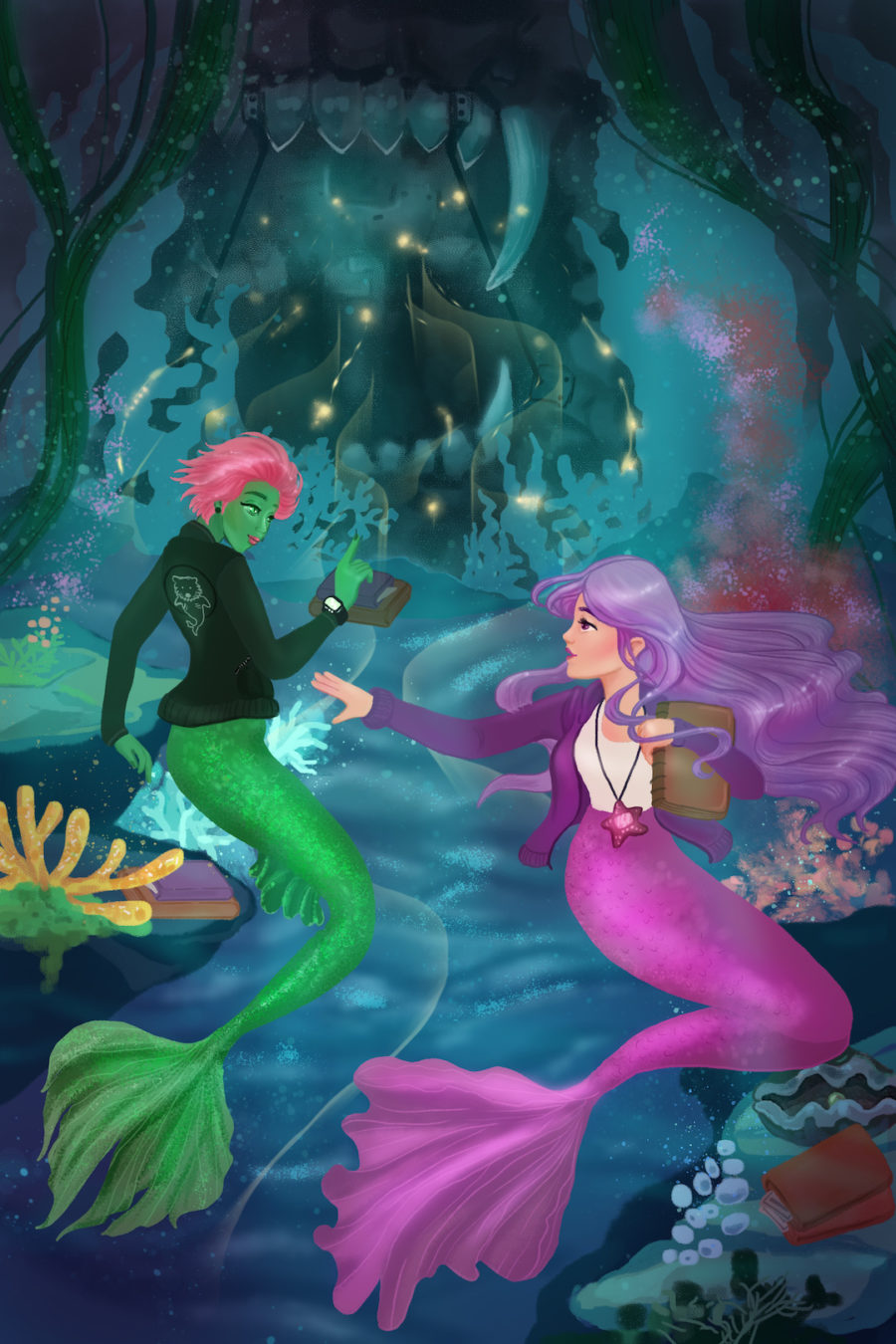
Prompted by a mysterious advert, a pair of mermaids travel to a cave that promises to make people better in every way.
Nerine struggled to keep up with Océane as they swam through the field of neon purple seaweed. Every mermaid at their school was jealous of Océane’s speed and agility. Nerine knew Océane’s vigorous training regiment that she put herself through and honestly didn’t mind trailing behind her best friend. As Océane continuously pushed herself to be better, she didn’t put that pressure on her friends, which Nerine appreciated. Nerine was tough enough on herself.
Nerine put her hand on her networker, which her model resembled the look of a red starfish necklace. A display of holographic icons emitted out from the device. She tapped on the map icon, bringing up a 3D model of the area to figure out where Océane was taking her. No point of interest markers appeared. She sent out a call.
“Where are we going?” Nerine asked, using the networker to transmit her voice as a thought Océane heard via her networker.
“It’s probably fake,” Océane said back. Her networker had the appearance of a smiley face watch around her wrist. “There’s supposedly this cave that promises to make those who enter it better in every way.”
“But, you’re already awesome.”
“You know it,” Océane said with a playful wink. She stopped and faced Nerine for a serious talk. She unzipped a pocket on her black aquatic jacket that sported their school’s logo and pulled out a plastic flyer. “I found this floating around outside after class. This place is guaranteeing to make you better. For all I know, it’s just a drug dealer, or maybe they’re legit in bettering people. I thought with you being a journalist, this could be an interesting story.”
“This could be exciting for our school broadcast,” Nerine admitted. “I don’t get why you didn’t just tell me this upfront.”
“Cause I love whisking you away on an adventure without explanation,” Océane teased as she swam forward, putting the flyer away.
As they swam deeper, the seaweed gradually changed colors from bright neon to a sickly gray, and fish were less common. Océane slowed down, carefully swimming alongside Nerine. Their networkers brought light to the area as they approached a cave. The entrance had a metal facade resembling an immaculate jaw of wolf teeth. There was no signage like the entry was the sign. Nerine thought it was an interesting artistic choice to display strength. From the looks of it, Nerine bet the jaw could open and close too.
“This is the place,” Océane announced, creeped out by the decor. “Think anyone is inside?”
Nerine swam forward. “Might as well find out.”
Océane caught up as Nerine activated her danger app should anything unfortunate happen. The app would send all relevant data, including location and media, to a user-determined list of contacts. Nerine used it almost every time she did an interview. The app has never saved her, but she found it reassuring to have it active.
Upon entering the cave, lines of electric neon yellow lights guided them through. The straight forward tunnel was unnatural in design with spiraling characteristics indicating the work from a drill machine twice their size. They didn’t travel far before they entered a vast, brightly lit room with metallic blue walls.
Down below in the room, they discovered piles upon piles of flayed merpeople corpses mixed with scrap metal. Océane covered her mouth while Nerine used her networker to take pictures of the bodies.
“This is going to be epic,” Nerine said with giddy.
Océane felt the opposite. “Maybe we should leave and contact the protectors?”
“Don’t worry. I already activated my danger app. Let’s investigate!”
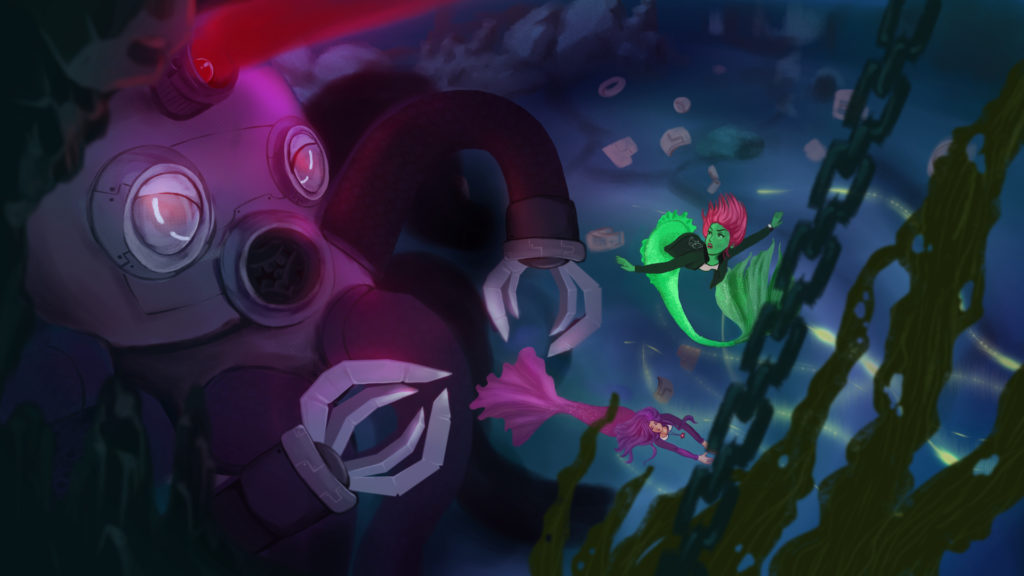
A red light focused on them, nearly blinding them. A colossal mechanical octopus – the size of a blue whale – emerged from the bodies, as the red spotlight on its head remained focused on the mermaids. Its black rubber tentacles twirled about with no pattern nor motive, but they still put the two on the defensive. Its white eyes housed in the metallic silver body were the size of Nerine and Océane. Overall, the mechanical was in pristine condition without any visual indication anyone had fought it.
“Have you come here for an upgrade?” the octopus asked with a lively, elitist tone. “I can make you swim faster and be stronger, leaving your weak flesh behind.”
“I like who I am,” Océane firmly defended.
“What she means is,” Nerine interjected, “we would like to know more about this upgrade service before we commit.”
The octopus opened its mouth, revealing an automated factory soaked in blood. “I strip the flesh that makes you weak and replace your mind with blissful logic.”
“Oh, well, as I said earlier, I’m happy with who I am, so we’ll just be leaving now.”
“Why?” Its eyes changed color to red. “When you can be better.”
The mechanical whipped out a tentacle at the mermaids. They split up, dodging the grab.
“Get out of here, Nerine! I’ll distract it.”
“Got it! I’ll see if we can’t lock it in.”
Nerine escaped through the tunnel while the tentacles pursued Océane. She dodged every swipe until she caused the mechanical to get tied up in a knot with two of the tentacles. With it focused on trying to undo the knot, Océane zipped out through the tunnel. The yellow tunnel lights were now dark red. Another tentacle followed.
Océane made it out of the cave.
“Océane, help me close this!” Nerine called out. She was on top of the entrance with her back against the metal jaw, trying to shut the door.
Océane swam up to help, but then the tentacle wrapped itself around her.
“Barnacles!” Océane cursed as she fought to wiggle free.
Nerine gave an extra hard push, causing the jaws to close and bite off the tentacle. It immediately loosened its grip on Océane. Nerine hugged her friend, and she hugged her back.
“Let’s get out of here,” Nerine suggested.
“Agreed. That should be the last of that.”
“I don’t think this is over yet.”
“What makes you say that?”
“You saw all those corpses. What if it did convert merpeople into mechanicals?”
This week’s short story was roughly inspired by the following writing prompt: “There is a strange cave where, rumor has it, the people who go in come out better in almost every way. Deciding to investigate you walk into the cave, and soon discover piles upon piles of flayed corpses.”
I haven’t written any short stories on the Blue Planet, which is part of the Five Following Planets system. I liked how this turned out, especially the “is it over” ending.
I feel like this story has the potential to be a young adult novel. I got a few ideas of what that story could look like and how parts connect with my universe. I’ll see what people think, but for now, thank you for reading!
UPDATE: It’s officially going to be a book. This and their other story, Temple Guardian, are part of the book.
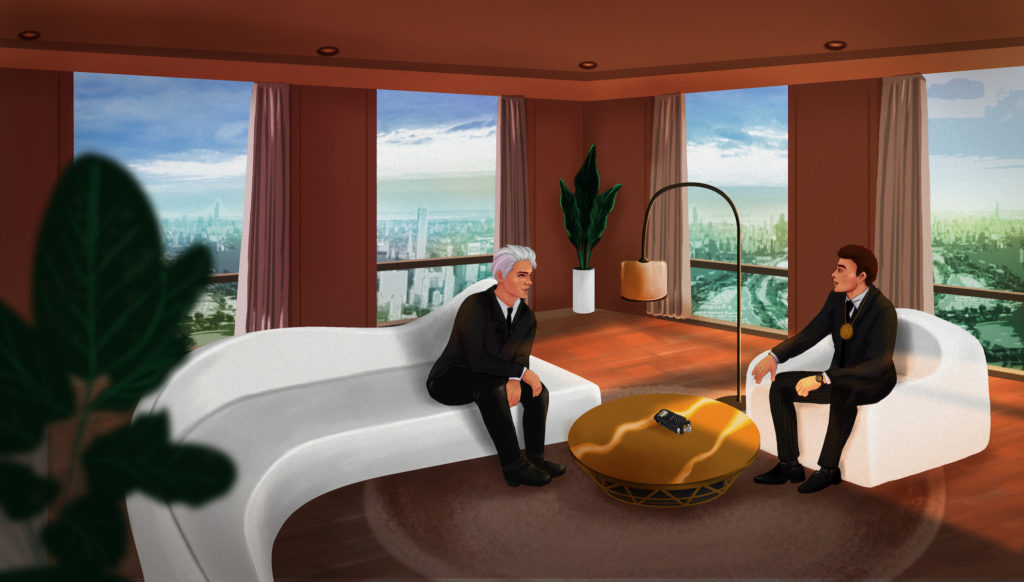
Thank you to Janine De Guzman at Design Pickle for bringing this scene to life with both pieces of artwork!
Be sure to subscribe to my website to get an email whenever I publish a new post or short story. The subscription form is in the sidebar or down the bottom if you’re on mobile.
During her morning jog, Janelle comes across a mysterious new boutique selling personalities.
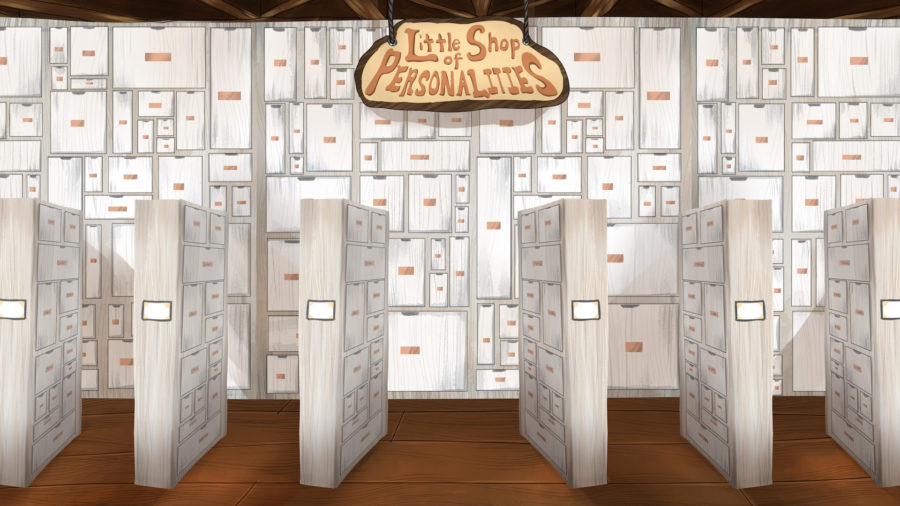
Janelle halted her morning jog when she came across an intriguing new boutique as yesterday, the retail space was empty. Through the glass windows, Janelle would’ve for sure seen people installing the drawers that covered the walls from the floor to ceiling. The shop was part of her apartment complex in Film Row, and she couldn’t recall reading about it in the Oklahoma Gazette or her neighbors talking about it. As Janelle thought back, she could’ve sworn when she passed by during the start of her daily run there was a “For Lease” notice on the door instead of a cheerful “Open” sign.
With time to spare and her curiosity piqued, Janelle went inside. All three walls were covered in drawers of varying shapes and sizes but had a matching white, rustic farmhouse esthetic. The beach lavender aroma put her in a relaxed state of mind. Janelle walked over and inspected a label on a drawer. It read, “Brave.”
“Good morning!” a cheerful female voice called out, catching Janelle off guard.
Standing in the center of the room was a young woman in a red satin dress holding a transparent tablet device. Next to her was a taller, slim man in a pink suit with bold, black outlines. Both had black hair and lanyards holding placards with their names, Raven and Loki, respectively.
“Welcome to Little Shop of Personalities,” Loki greeted with what Janelle thought was more energy than any average retail worker would have this early in the morning.
“Shop of Personalities?” Janelle repeated, confused.
“Yes. We sell a wide assortment of personalities that you can give yourself to change your life,” Raven explained. “If you want to be more likable, we can help.”
Janelle kept her skeptic tongue to herself. She figured this whole ordeal was some pop-up artistic expression or experience. She scanned the drawers and noticed they were all labeled with various personality traits, including negative ones.
“Why would anyone want something like an ‘obsessive’ or ‘creep’ personality?” Janelle inquired.
“You can give them to others,” Loki revealed.
“Including your enemies,” Raven added with a wink and a wave of her finger.
“Weaponize them to get rid of unpleasant coworkers,” Loki commented, and Raven nodded in agreement.
“Buy as many as you like.” Raven smiled. “But no returns.”
Janelle turned her attention to the drawer that caught her initial focus, the one labeled, “Brave.” She opened it up and pulled out a white index-sized card with the word written in a bold font fitting of the name. Even if the card didn’t magically give the trait, she thought it would make for a cute decoration for her desk.
Janelle showed the shopkeepers the card. “How much for this one?”
“Since you’re our first customer,” Loki started.
“Your first personality is free,” Raven finished.
Janelle closed the drawer. “So, how does this work?”
“Simply put the card on the forehead of the person you wish to give the personality trait,” Loki explained.
“I’ll take this one and try it out,” Janelle said, still skeptical. “Thank you.”
To keep the card from getting bent, Janelle held it until she returned to her apartment. Once inside, she tossed her keys on the kitchen counter. She looked at herself in her hallway mirror and put the card up to her forehead. The card faded like her body had fused with it. Instead causing her to freak out, the new personality had filled her with excitement.
Janelle went about her morning routine with vigor as she arrived, first as usual, to the law firm. She took one look at her desk, marched to the break room for a box, and pushed all of her belongings inside. Her boss, whose name was on the sign outside, found Janelle packing up.
“Everything okay?” Janelle’s boss asked her with concern.
“Never better. I’m going to start the yoga studio that I’ve always been too afraid to do.”
“Good for you, Janelle! If you ever do a beginner’s class, I’ll sign up.”
“Thank you. That means so much. Everyone here has been so great to me, but I must move forward.”
Janelle left the law firm with her box, her mind racing with a business plan. In the cleanup process, she decided to open her yoga studio in her apartment complex. There were several vacant spots. She knew one of them would be perfect.
As she walked back to her place, a dog ran across the street, chasing a squirrel. Janelle could see the bus hitting the dog. Without hesitation, she dropped her box and pushed the dog to safety and the bus hit her.
A few hours later, Janelle woke up in a hospital bed. Every part of her felt numb. She rolled her head and saw Raven and Loki standing over her.
While Raven wrote notes in her tablet, Loki held out a bouquet of spring flowers. “All sales are final.”
This short story was first published on the Oklahoma Gazette for their Writers of the Quarantine series. The Loki and Raven story was inspired by the following writing prompt: “A new shop shows up in town. Upon entering the walls are made entirely of drawers, each with a different personality trait written on them. The shopkeeper smiles – ‘Buy as many as you like, but no returns.'”
If you enjoy my story, please share it! I would love to have more readers. If you want to help me more, join me on Patreon and you’ll get beta access to my novella, Intertwined by Cracks. The urban sci-fi story follows Amber Way who can make doors lead to other doors as she deals with cracks leaking monsters from other planets in a plan from a stranded time traveler to harness her powers.
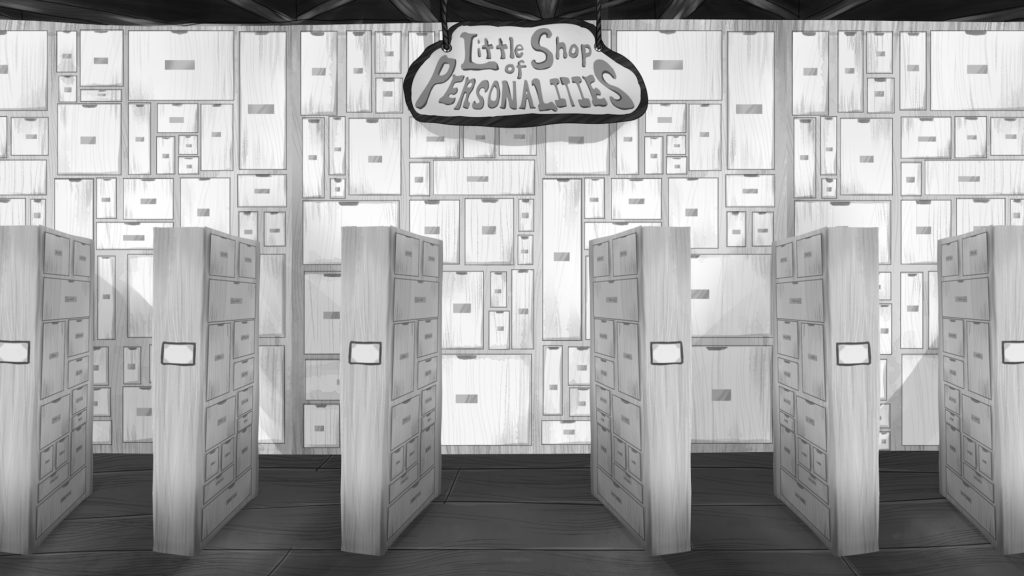
Story Artwork by Keith Zarraga at Design Pickle. Get a discount off your first month of Design Pickle via this affiliate link, which full disclosure, I earn a small commission as a discount for me as well.